
0%
Loading ...




Nearly more than 60% of large construction projects run over budget or behind schedule. Building is not something about bricks and cement. From defining the project requirements to handing over the completed building, every stage requires careful planning, coordination, monitoring, and decision-making. This is where construction project management plays an important role.
Construction project management brings together people, processes, budgets, timelines, materials, and resources and ensures projects go from conception to execution according to plan.
If you’ve ever wondered what actually happens between “we have an idea” and “here are your keys,” here’s the journey broken down into six clear stages.
At this stage, the project management team identifies project scope, objectives, estimated budget, expected timeline, site conditions, and other major requirements. The feasibility study may also be done to identify any possible risks and limitations.
After defining the basic needs for this project, the team will develop an elaborate plan of work. It gives clear guidance to all parties involved in the project and helps avoid confusion later on.
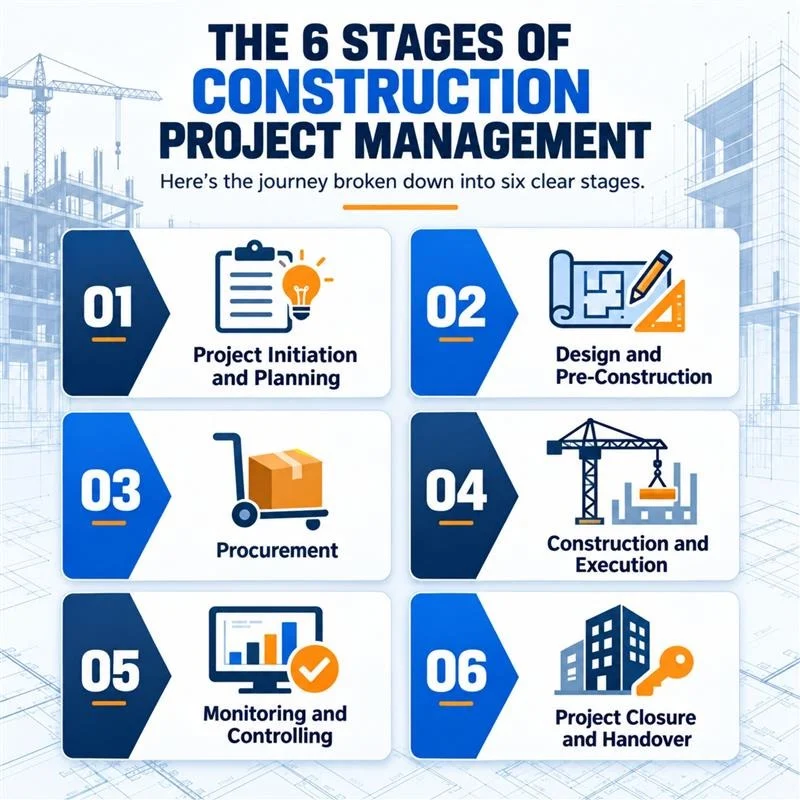
After defining project requirements, the team will move forward with more detailed design and prepare for construction.
Pre-construction planning also includes preparing cost estimates, construction schedules, procurement plans and resource requirements. Recognising possible problems now would prevent expensive modifications and delays later on when building begins.
With a plan in hand, it’s time to actually get the resources needed to build. Procurement ensures the availability of such materials at the required time.
Depending on the project, procurement might include selecting and contracting vendors and suppliers, hiring contractors and subcontractors, negotiating costs and delivery timelines, and ensuring materials meet quality and compliance standards.
Effective procurement is not simply about finding the lowest price. Quality, reliability, delivery schedules, technical suitability, and the supplier’s track record also need to be considered. Good planning for procurement ensures that a project is moving forward with less chance of shortages of materials, quality problems, and cost overruns.
Execution is where the plan gets put into action on-site. Key activities include coordinating daily construction activities, managing labor, equipment, and material flow, ensuring adherence to design and engineering specifications, maintaining safety standards on-site, and communicating progress with stakeholders.
Execution is also the stage where a strong project manager makes the biggest visible difference. They simultaneously oversee multiple teams and activities, coordinate contractors, consultants, suppliers, and site teams while monitoring progress against the approved schedule and budget.
The project manager also continuously monitors safety, quality control, material usage, and compliance with drawings and specifications. Regular site inspections and progress reviews help detect problems at an early stage so that corrective measures can then be taken before they affect much of the project.
This stage runs alongside execution rather than after it. Projects are successful if they are monitored periodically to ensure that they are progressing according to plan.
Project managers track critical factors like cost, schedule, workmanship, as well as material quality, resource utilisation, and overall progress. Any deviation from the approved plan needs to be identified and addressed.
For instance, if an activity is delayed, then the project team may need to change manpower, resources, or sequencing to minimise its effect on the overall timeline. Similarly, regular inspection will be able to detect bad products earlier, before they progress to the next stages.
Effective oversight and management ensure the completed work meets the required standards.
The final phase starts after major works have been finished. Nevertheless, finishing a building does not always mean it is time to hand over the project. Final inspection, testing, documentation, approval, snag rectification, and commissioning may need to be completed prior to closing out the project.
Project members confirm compliance with specifications, as per the agreement, and resolve any outstanding contracts or payments.
Important documents such as warranties, operation and maintenance manuals, as-built drawings, and completion certificates may also be handed over to the client.
A structured closure process ensures a smooth transition from construction to the building’s operational phase.
Six phases of construction management are closely related. Poor planning may cause delays in procurement, while delays in construction and poor supervision may result in cost overruns and quality issues.
Good project management for construction projects ensures proper planning, coordination, and control across all stages. By maintaining control over time, cost, quality, resources, and risks, project management helps turn a construction plan into a successfully completed project.
The stages typically include initiation, planning, design, procurement, construction, and closeout. Each stage helps ensure better control of cost, time, quality, and risk.