
0%
Loading ...





Planning a construction project includes not just calculating costs for materials and labour but also other factors like design specifications, timelines, etc. Coordination of contractors, tracking progress on time and budget are important parts of successful project management. This is where a Project Management Consultancy (PMC) comes in. They are the single point of contact for your project.
However, one of the common questions that property owners and developers often have is how much a PMC charges for real estate development projects in India. The answer depends on various aspects such as project scale, complexity level, time frame for completion and range of service needs. Knowledge of various types of PMC fees will assist in planning a proper building cost estimate as well as selecting the right consulting firm to handle it.
In India, PMC fees are commonly calculated as a percentage of the total construction cost, a fixed lump sum, or a monthly fee. Actual amounts vary according to project needs and the level of involvement expected from the consultancy.
For instance, if the estimated construction cost is ₹5 crore and the agreed PMC fee is 3%, then the total consultancy fee would be ₹15 lakh. It’s just a sample here, as it depends on what service you have purchased under this contract.
Before comparing quotations, it is important to understand how PMC fees are calculated.
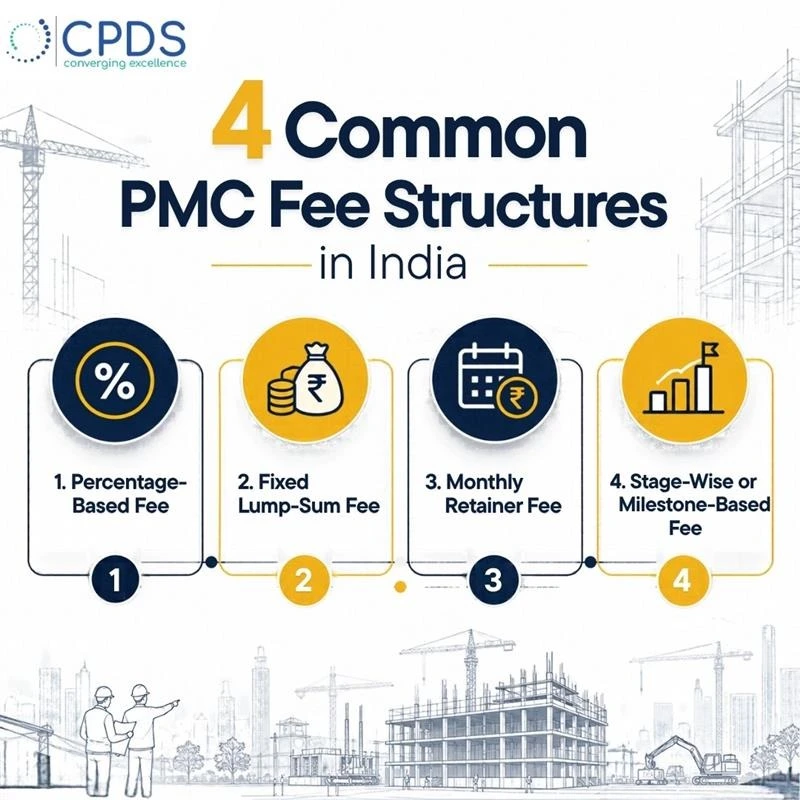
This is the most common model in India. The PMC charges a fixed percentage of your total project cost. Typically, this percentage ranges between 2-5%. For example, if the budget of the project is ₹ 10 cr and the PMC fee is 2.5%, then the consultancy fee would be ₹25 lakh.
The model works well for projects that involve consulting services during all stages of building, such as the design phase, contractor coordination, quality checks and post-project evaluation.
However, clarify what counts as the construction cost. Depending on the agreement, it may be excluded from calculations, such as land cost, tax, statutory charges, machinery or other expenses.
Under a lump-sum arrangement, you and the PMC agree on one total amount for a clearly defined scope of work.
For instance, an agency might charge ₹12 lakh for managing a project at specified stages of construction. The fee is constant if there are no changes to the scope of work, delivery specifications or timelines.
It provides better cost certainty and is more straightforward for budgeting purposes. Nevertheless, more expenses might be incurred due to additional work, major design changes or project extension fees.
A fixed-fee structure is especially effective if there is a clear definition of the project requirements at its outset.
Some companies charge a fixed monthly fee for continuous project management services. This kind of contract is usually appropriate when you need ongoing monitoring at a location, frequent site visits, progress reporting and contractor coordination.
Monthly charges might vary depending on how many employees are hired for it, site visit frequency, project location, and its level of responsibility.
Although it helps us predict the costs more accurately each month, the overall price is determined by the duration of a project. The delay may lead to higher costs for consulting services due to a lack of specified time limits within an agreement.
In this arrangement, PMC payment is tied to particular stages of the project. Scheduling of payments can be agreed around planning, design coordination, tender process, construction supervision and project handover.
It enables customers to link payment terms with agreed delivered services and project progress. It also helps to manage cash flows throughout the building project.
Nevertheless, an agreement must specify a particular stage of completion along with its associated fee as well as approval criteria for finished projects.
Project management consulting fees are not solely determined by an organization’s building costs. There are several other things that may influence a price quote.
When evaluating PMC charges in India, do not focus only on the headline fee. Check whether the quotation includes all the services you need.
According to an agreement, there could be extra costs like travel and accommodation, specialist advice, legal approval, external inspection by a third party and other services beyond what was originally agreed upon. Applicable taxes, including GST, should also be clarified.
It is equally important to understand how changes in the construction budget will affect a percentage-based fee. If the project cost increases, the PMC fee may increase accordingly, depending on the agreed calculation method.
A detailed fee breakdown should be provided along with an initial statement of exclusions to avoid surprise costs down the line.
PMC fees in India generally fall between 2% and 5% of project cost, depending on the fee structure, project size, and scope. The right model depends on your project: percentage-based for clear budgets, fixed fees for defined scopes, and time-based or hybrid models for larger, evolving ones.
Treat the fee as an investment in control. When your project stays on time and on budget, the PMC’s cost is usually the smallest line item that saved you the most.